

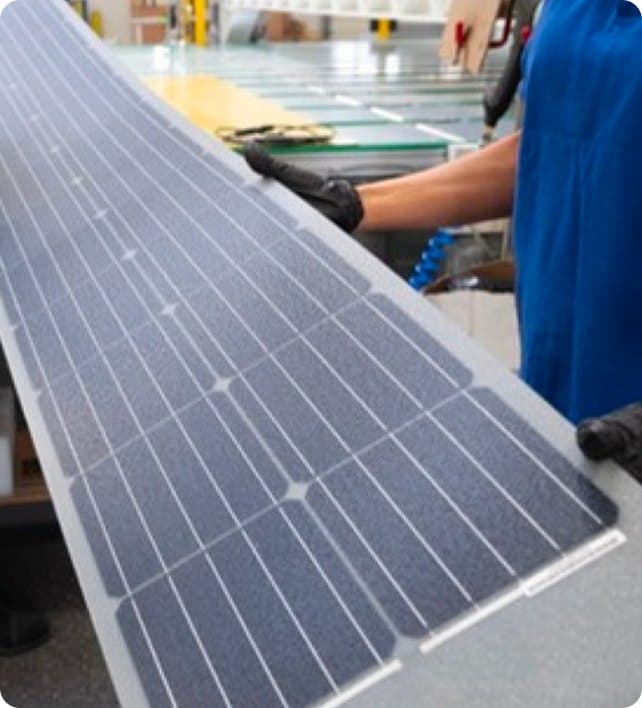
A patent describes that something can work. Series production proves that it works reproducibly – for every module, over years, exposed to the weather. Between those two points lies the real development effort.
Weight is the limiting factor
On a large share of existing roofs in Austria, a photovoltaic system fails not because of area, not because of the grid connection and not because of economics, but because of load reserve. A conventional glass-glass module with substructure and ballast places loads on the structure that an older hall or a lightweight roof can no longer absorb.
The usual answer is to reinforce the structure. That is technically possible, but it fundamentally changes the economics of the project – and during ongoing operations it is often simply not feasible.
Not every roof needs a stronger structure. Some simply need a lighter module.
What makes the build-up different
Our HYBRID composite replaces the front glass with a multi-layer laminate structure. The load-bearing function is no longer carried by a single pane but by the interplay of the layers. This significantly reduces the surface weight without changing cell output – the electrical side remains standard.
The hard part was not the build-up itself but the process control: lamination profile, edge sealing and mounting interface must remain stable through temperature cycles and over years. That was precisely the focus of the series development.
Where the technology delivers its value
- Existing roofs with little structural reserve, where reinforcement is not economical
- Lightweight and trapezoidal sheet-metal roofs in industrial and commercial construction
- Listed or architecturally sensitive surfaces with requirements for colour and finish
- Facade surfaces where weight and mounting grid are limited
- Custom formats that standard modules cannot cover sensibly
From sample to batch size
In practice, series production means identical process parameters, documented batches, repeatable test results. Every module passes electrical testing and a visual inspection of the laminate; the process data stays linked to the batch. That is the precondition for a warranty over the system's lifetime to be reliable at all.
For projects this means custom formats are no longer one-off productions with the corresponding price and schedule risk, but a variant within an ongoing production line.